 MEYADE
How to Play Foot Tennis: Rules, Scoring and Tips
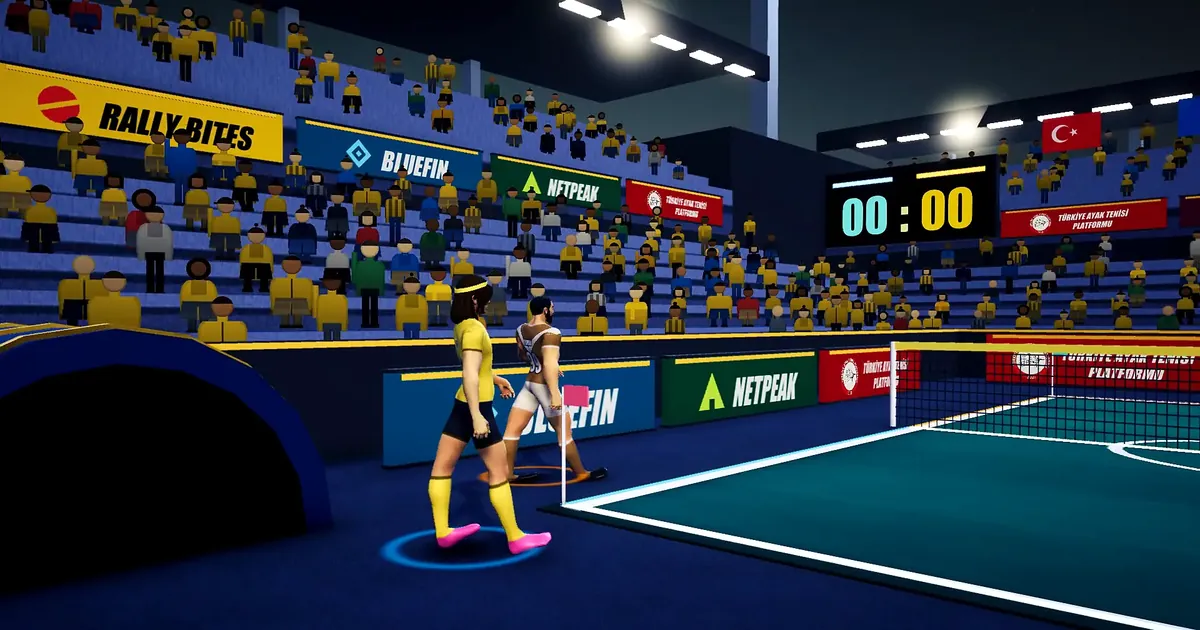
Foot tennis (also called football tennis or soccer tennis) is a net game played with a football: two sides, a net about 1.1 metres high, and no hands. You can use your feet, thighs, chest and head to control the ball and send it back over the net. Each side gets a limited number of touches and may let the ball bounce once. The game started in Prague in the 1920s, when footballers began kicking a ball over a rope, and today it is played as singles, doubles and triples.
This guide explains the rules of the real sport, how a match is scored, and a few tips for your first games. The last part shows how the mobile game Foot Tennis Stars turns those rules into something you can play with your thumbs.
The rules in 30 seconds
- No hands or arms. Any other part of the body may touch the ball.
- Touches: singles players get up to 2 touches per side; doubles and triples teams get up to 3.
- Bounces: the ball may bounce once on your side. A second bounce loses the point.
- In doubles and triples, the same player may not touch the ball twice in a row. In singles you may.
- Every rally scores a point. The side that wins the rally serves next.
- A set goes to 11 points with a two-point lead (the rulebook caps it at 15). A match is best of three sets.
- You lose the point if the ball lands out after your touch, if you touch the net, or if the ball touches your arm or hand.
Rules differ slightly between federations and competitions. The details below follow a national rulebook translated from the international federation's rules, the federation's tour regulations and an encyclopedia summary (see the sources at the end).
The court, the net and the ball
- Court: 9 m wide and 12.8 m long for singles and doubles, split by the net into two halves of 9 × 6.4 m. Triples use a longer court, 9 × 18 m. The lines count as part of the court.
- Service zones: in singles and doubles, a centre line splits each half lengthwise into two boxes of 4.5 × 6.4 m, like a small tennis court.
- Net: the top of the net is set between 1.08 and 1.12 m (so about 1.1 m). For women and junior players the rulebook lowers it to 1.00 m.
- Ball: a football with 32 panels, 396–453 g and 680–710 mm around, so roughly a standard size 5 ball. Younger children may use a lighter ball.
At home you don't need any of this. A badminton or volleyball net set low, a chalk line and any football will do.
Singles, doubles and triples
- Singles: one player per side. The two-touch limit makes singles a game of control: a touch to settle the ball, a second to send it over.
- Doubles: two players per side, up to three touches between them, and no player may touch twice in a row. The usual pattern is receive, set, attack, like volleyball with your feet.
- Triples: three players per side on the longer court, with the same three-touch rule.
There are also mixed categories, and juniors may be allowed an extra bounce.
How to serve
- Stand behind the baseline. Neither you nor the ball may touch the line while you serve.
- Kick the ball with any body part except your arms and hands. You can drop it from your hand and kick it in the air, kick it after it bounces, or kick it straight off the ground.
- Serve within 5 seconds of the referee's whistle.
- The serve must cross the net and land in the receiver's service zone (or hit the receiver). A serve that clips the top of the net and still lands in is good.
- In singles and doubles the serve goes diagonally, like in tennis: from the right when the server's score is even, from the left when it is odd. In triples the serve may land anywhere in the opponent's service zone, the part of their half nearest the net.
- Whoever wins the rally serves next.
Playing a rally
- After the ball crosses the net, your side may let it bounce once and use its touches (2 in singles, 3 in doubles and triples) to send it back.
- At least one touch is needed before the ball goes back over. If you receive a serve in the air, your side needs at least two touches.
- The ball can't go over the net straight off a bounce: someone has to play it.
- You may reach over to the other side to play the ball only if you take off from, and land on, your own half.
- Touching the net with any part of your body loses the point.
Scoring a match
Foot tennis uses rally scoring: every rally ends in a point for one side, whoever served. A set is played to 11 points, and you must win by two. The rulebook caps a set at 15 points; some professional tours instead play one deciding point at 12–12. The first side to win two sets wins the match. Between sets there is a one-minute break, and each side can call short time-outs.
Ways to lose a point
- The ball bounces twice on your side.
- Your side uses too many touches, or the same player touches twice in a row (doubles and triples).
- The ball touches a hand or arm.
- You touch the net.
- Your shot lands outside the opponent's half, or passes outside the width of the net.
- Your serve misses the service zone, or you step on the baseline while serving.
- Indoors: your shot hits the ceiling.
Tips for your first games
- Use your first touch to slow the ball down. A soft touch with the thigh or the inside of the foot buys you time. In singles, that gives you one touch to place the ball over the net.
- Let it bounce when you are unsure. The one bounce you are allowed is there to help you; a ball taken early in the air is harder to control.
- Aim deep and wide. A ball that lands near the back corners forces your opponent to move and makes their first touch harder.
- Lob a player who stands at the net, and smash a high ball that drops near the net on your side.
- In doubles, talk. Call "mine" or "yours" early, and decide who sets and who attacks before the point starts.
- Practise keepy-uppies. Ball control with the thigh, foot and head is most of the game.
Foot tennis on your phone: how Foot Tennis Stars adapts the rules
Foot Tennis Stars is a free foot tennis game for iPhone, iPad and Android. The heart of the sport is the same; the parts that don't work on a touchscreen are simplified.
| Real foot tennis | Foot Tennis Stars | |
|---|---|---|
| Players | Singles, doubles, triples | 1 v 1; 2 v 2 with friends |
| Touches per side | 2 in singles, 3 in doubles and triples | Up to 3, and you can bounce the ball up for yourself |
| Bounces per side | 1 | 1; a second bounce loses the point |
| Ball out | Last side to touch it loses the point | The same |
| Serve | From behind the baseline, must land in the service zone | Must clear the net, or it is a fault |
| Who serves | The rally winner | The rally winner |
| Match | Best of three sets to 11 | One game to 7, 9 or 11 points (your choice) |
| Win by two | Yes, capped at 15 | Yes against the computer, with a cap; online, first to the target wins |
The controls are simple. Your left thumb moves the player. PLACE is a controlled shot, LOB goes over a player at the net, SMASH hits down hard, and BOUNCE sets the ball up for yourself. Hold SMASH for a bicycle kick; smash a high ball at the net for a scissor smash. In 2 v 2 a PASS button gives the ball to your teammate, and teammates take turns, just as the real doubles rule asks.
There is also a Lightning match for when you only have a minute: first to 3 points, and at 2–2 the next point wins. You can play against computer rivals without internet, or online, where iPhone and Android players meet in the same match. The game is free, with ads and optional purchases. More on the Foot Tennis Stars page.
Sources
- Fodtennis Danmark, Fodtennis reglement (August 2017), a national rulebook translated from the international rules of FIFTA, the Federation International Footballtennis Association: court, net, ball, serve, touches, bounces, faults and set scoring. PDF, in Danish
- FIFTA, Pro Tour regulations: best-of-three-set format, sets to 11 with a two-point margin and a single deciding point at 12–12. fifta.net
- Wikipedia, Footballtennis: history (Prague, 1922), the sport's other names, governing bodies, court and net sizes, touches and bounces by discipline. en.wikipedia.org
Checked on 13 November 2026. If you play in a league, your league's own rules come first.
Play Foot Tennis Stars on the App StoreGet it on Google Play